She sat down hungry. Not just peckish — hungry. The kind of hungry where you’ve already decided what you want before you’re through the door, and your stomach is running the show.
She wanted an omelette.
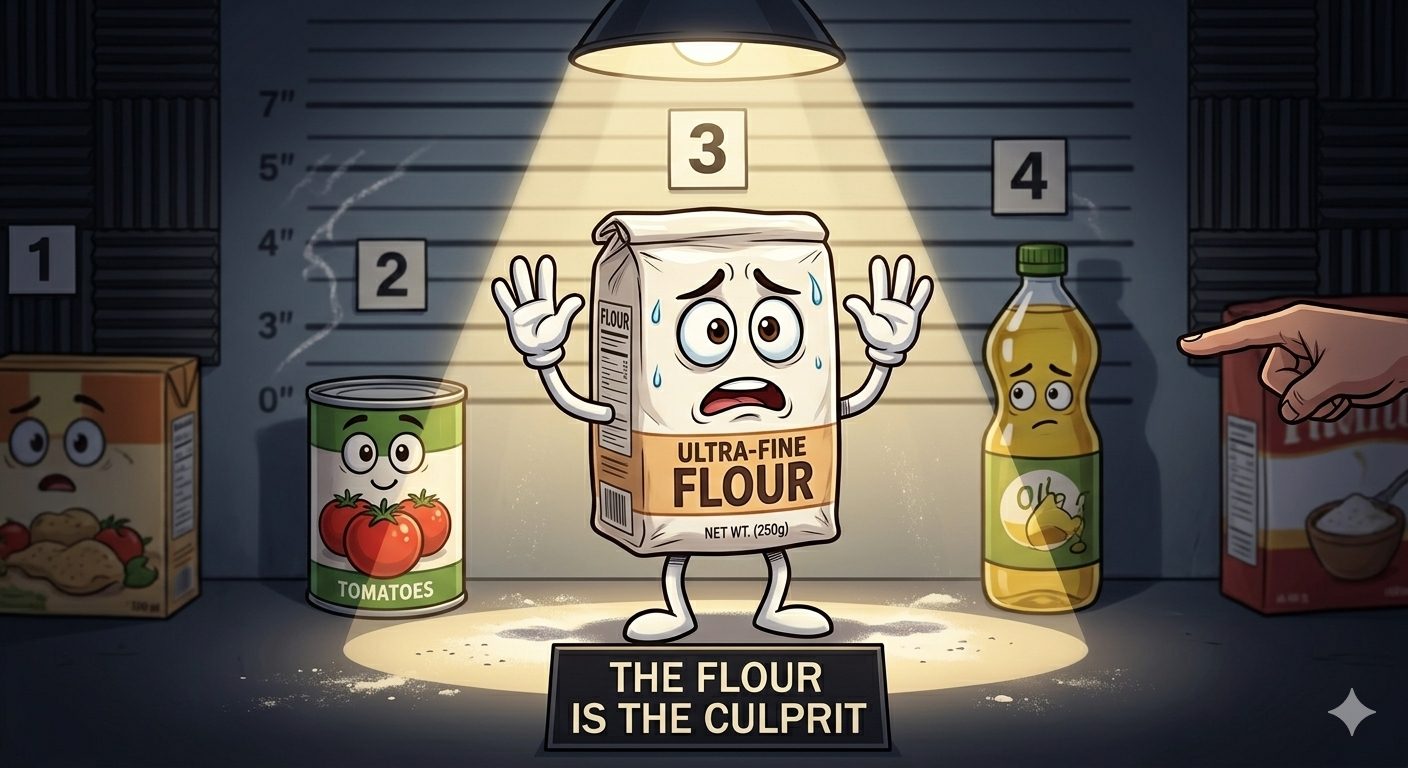
The server — sweet, slammed, five coffee refills deep, two tables waiting on their check and one still un-greeted — took the order with a smile and disappeared to the POS. And here’s the part nobody sees: the moment she walked away, that omelette was already dead. The kitchen had been out of flour since the last rush. No omelettes. Hadn’t been for an hour.
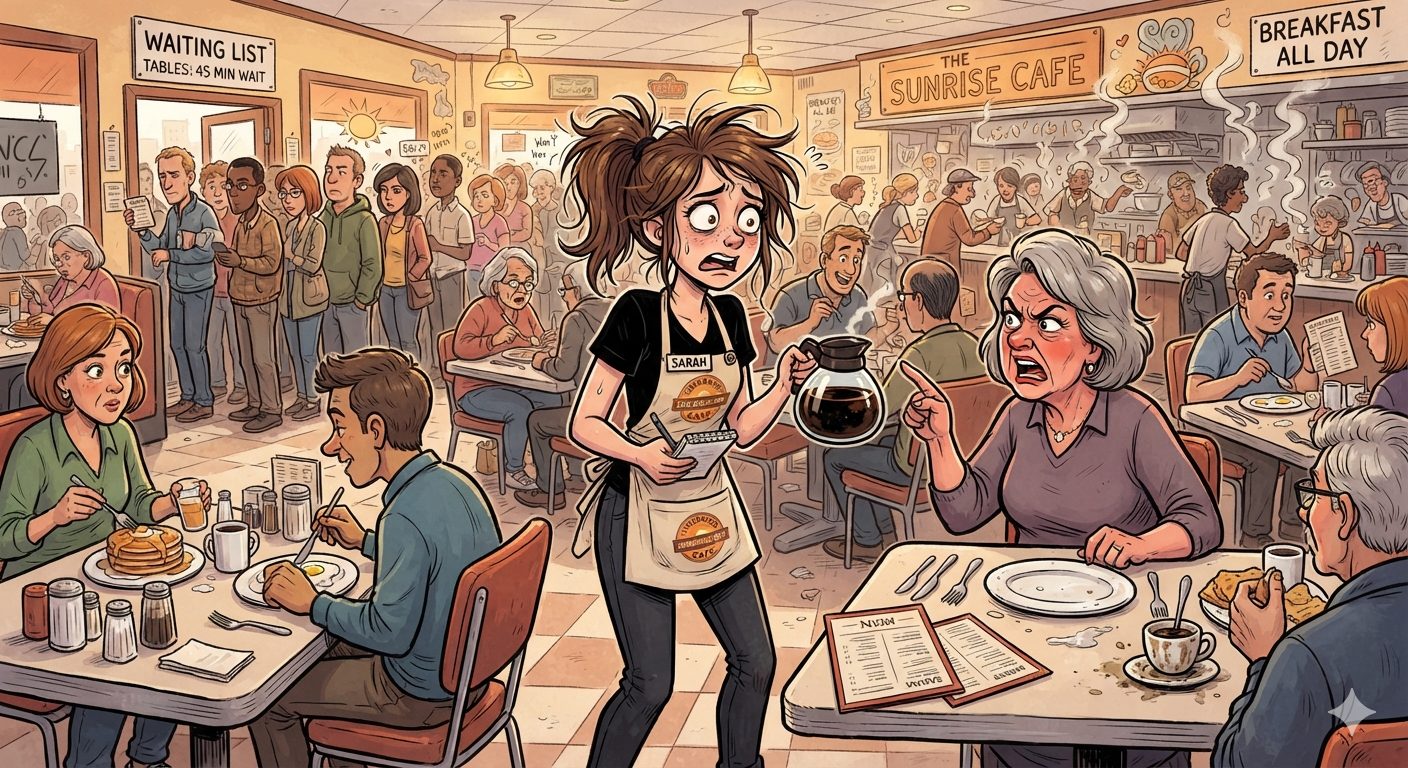
Nobody told the server. Why would they? The kitchen is buried. The manager’s somewhere. The little “86” note is on a whiteboard by the line that the server hasn’t stood in front of since her shift started. So she rings it in, confident, and goes to refill three more coffees.
Fifteen minutes later she comes back to a table that has now crossed from hungry into hangry. “I’m so sorry — we’re actually out of flour, so no omelettes today.”
You know exactly what happens next, because you’ve been this customer. The face falls. The stomach growls louder in protest. “Well… what do you have? How about pancakes?” — and you and I both know what’s in pancakes, but the server, in the weeds, says “Sure! What kind?” “Blueberry.” Her mood lifts. She can taste them already. The server vanishes again.
Five more minutes. “I’m so, so sorry —”
She’s gone. Out the door, cursing a server she’s decided is incompetent, cursing a restaurant that “can’t even keep flour in stock,” pulling out her phone. She never comes back. She tells her friends not to either.
And the server? She’s shaking. She did nothing wrong — she was never told — but she wore the whole thing on her face, twice, and she’s about to walk into her next table braced for the same humiliation. That’s how good servers start to quit.
Running out of an ingredient isn’t the failure. Every kitchen runs out of things — that’s Tuesday. The failure is that the person taking the order didn’t know, and the person who knew had no fast way to tell her. The 86 lived on a whiteboard, in the head of a line cook who’s drowning, in a manager’s memory that’s already holding forty other things. The information existed. It just never traveled the ten feet from the kitchen to the server’s hands before the guest heard “sorry” instead of “here you go.”
Multiply that by every shift, every out-of-stock, every table. It doesn’t show up as one big disaster. It shows up as a slow bleed — a one-star here, a walkout there, a server who “just isn’t feeling it anymore,” a regular who quietly stopped coming.
Front-of-house turnover runs near 96% in full-service restaurants — you replace nearly your whole floor in a year, at about $2,300 a head. TGI Fridays filed for bankruptcy. Denny’s is closing up to 90 more locations. When margins are this thin, the small, fixable, silent failures are the ones you truly can’t afford.
“They can’t keep staff, and they’re always slow.” People hear that and don’t apply. Guests hear it and don’t come. All of it downstream from problems that were, at the root, just someone didn’t know.
The fix isn’t fancy. It’s just fast, honest communication.
Picture the same morning, done right. The kitchen runs low on flour. The manager taps it 86’d — and it’s out of stock the instant he confirms. Not on a whiteboard. Everywhere. The moment that happens, every item that flour touches lights up — omelettes, pancakes, the breading on the chicken — and the server’s screen shows it before she ever walks to that table.
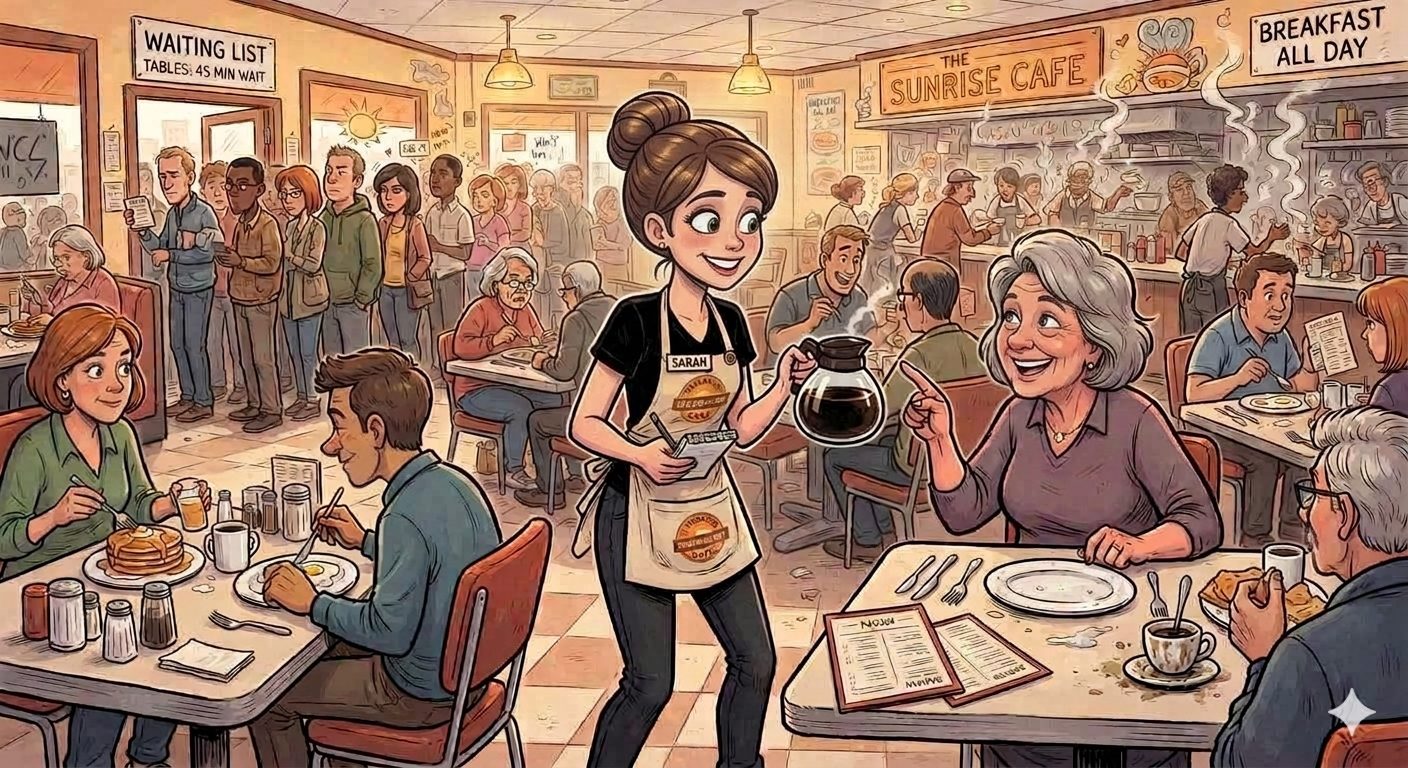
When the guest says “omelette,” the server already knows. She says, warmly, in the first thirty seconds: “I have to tell you, we’re out of flour this morning, so omelettes and pancakes are down — but the [thing that’s actually available] is incredible, want me to bring that?”
The guest isn’t angry. She’s taken care of. She never waited fifteen minutes to be disappointed. She never reached for her phone. The server never wore the shame. Nobody lost the table.
Why we care enough to build it
I’ve been the server shaking at her next table. I’ve been the guest waiting twenty-five minutes on a plate that was never coming. I’ve watched good people quit over something that was never their fault, and good restaurants get bad reputations over a problem that could’ve been solved with a tap.
That’s who we build for. The owner fighting to survive a brutal market. The server who deserves to look competent because she is competent. The guest who just wanted her omelette. Nobody in that story is the bad guy — they were all just failed by silence.
What if one button meant you never lost another table?
Convenience is one click away.
Get in touch— Acquired Taste Studios